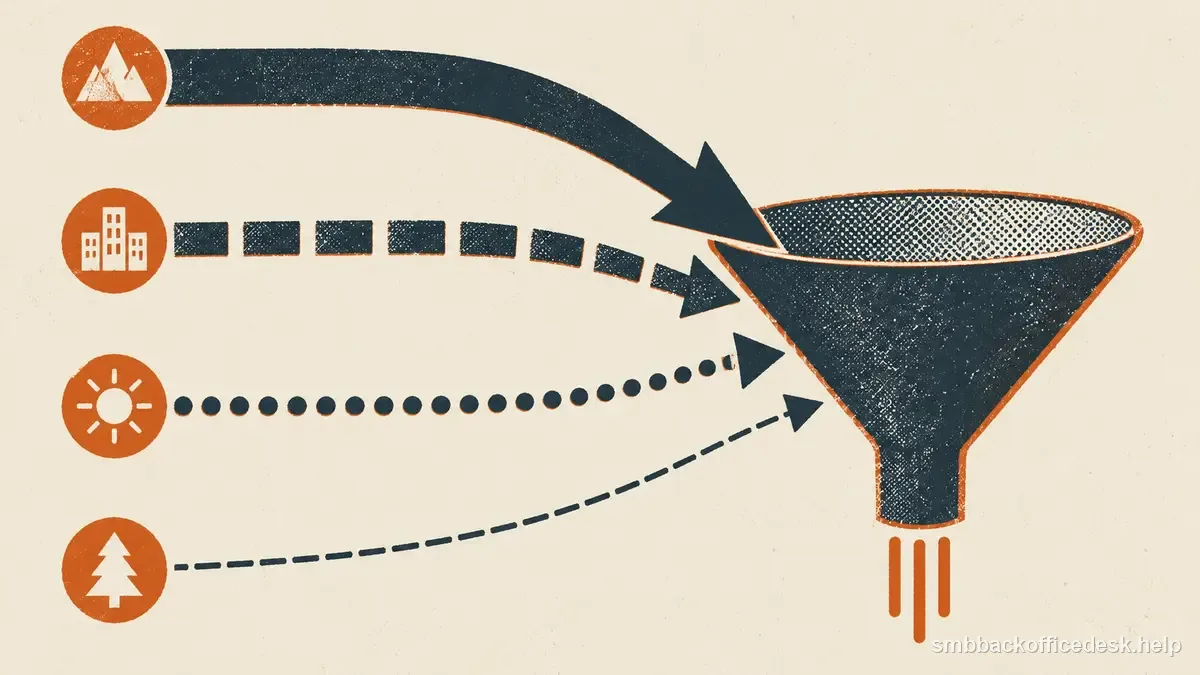
An ideal customer profile is useful only if two people can apply it to the same company and reach roughly the same decision. “Growing B2B companies that value quality” is positioning language, not a research specification. Before building a lead list, convert what you know about good customers into fields that can be observed, verified, and scored.
Start with customers that actually worked
Pull a small sample of recent customers or projects and add outcomes, not just revenue. Useful columns include gross margin or project profitability, sales-cycle length, retention or repeat purchase, implementation difficulty, support burden, and whether the buyer referred other customers.
Look for patterns that explain why the relationship worked. A software consultancy may discover that 40–200 employee manufacturers with an internal operations lead buy faster than larger enterprises because they have a defined problem but less procurement friction. A local commercial cleaner may find that multi-location medical offices produce better recurring work than restaurants even when both appear in the same city.
Do not turn one lucky customer into a rule. The point is to identify repeated characteristics worth testing.
Do not analyze only wins. Include churned accounts and representative closed-lost deals. Ask a few customers what triggered the purchase, which alternatives they considered, and what outcome they can measure; compare those answers with CRM, implementation, retention, and margin data. A lost deal alone does not prove poor fit: record whether the reason was no need, timing, budget, competition, or execution before turning it into a disqualifier.
Convert the pattern into searchable company filters
Use firmographic fields a researcher can verify: - industry or NAICS family; - geography served; - employee-size band; - location count; - business model; - technology or operational condition if relevant; - ownership or funding condition when it materially affects buying; - minimum complexity that creates the problem you solve.
NAICS is useful when industry boundaries are otherwise vague. The Census Bureau publishes the classification system and search tools. You do not need a six-digit NAICS code for every prospect, but mapping target and excluded industries to recognizable categories keeps researchers from improvising.
Avoid filters that are impossible to verify reliably. “Values innovation” might sound attractive but is not a defensible lead-list field. “Operates at least three physical locations” can be checked.
| Company fit | Buyer fit | |
|---|---|---|
| Industry, geography, size, business model, need | Industry, geography, size, business model, need | Person/function owning the problem. |
| Observable evidence and disqualifiers | Observable evidence and disqualifiers | Responsibilities can have different titles by size. |
| Decision context | Retain source evidence | Review after change |
Define the buyer separately from the account
The ICP describes the company. The buyer profile describes the people likely to own the problem. Keep these separate.
For each target account, identify one primary function and one or two fallback functions. A payroll service might target an owner at a 10-person company, a finance manager at a 50-person company, and HR at a 150-person company. The title changes with company size; the responsibility is the stable concept.
Write the responsibility in plain English: “owns payroll accuracy,” “controls vendor selection,” or “runs outbound sales.” This prevents a researcher from collecting every person with “manager” in the title.
Add disqualifiers before building the list
A good ICP says who not to include. Examples: - industry cannot use the product; - company is below the minimum operational scale; - geography is outside your service area; - the organization is already a customer or active opportunity; - the account is a competitor, vendor, or partner; - the business model conflicts with your pricing or compliance limits.
Put disqualifiers ahead of enrichment. Removing an obviously wrong account before you buy contact data saves money and reduces the temptation to keep a bad lead because you already paid for it.
Build a score that explains itself
Use a short score, not a machine-learning theater project. For example:
- +2 target industry;
- +2 target employee band;
- +1 target geography;
- +2 clear trigger such as expansion, hiring, or a relevant technology;
- −3 excluded business model;
- −5 existing customer or explicit do-not-contact.
Set an inclusion threshold and test it against known customers and known bad fits. If the score rejects half your best customers, change the model before using it for prospecting.
The score should support prioritization, not claim to predict purchase probability with scientific precision.
Test the ICP on a 50-account pilot
Before asking for 5,000 leads, have a researcher build 50 accounts manually. For each one, save the evidence that supports the key filters: company website page, public directory, filing, job posting, or other source.
Review false positives. If researchers keep including companies you would never sell to, the ICP is under-specified. If good-looking companies are excluded because the employee count is uncertain, decide whether the field is truly required or only directional.
Then test contacts. Can the researcher identify a plausible owner of the problem at most included accounts? An ICP that produces companies but no reachable buyer may need a different size band or function definition.
The handoff document should fit on one page
The final ICP sheet should contain target industries, geography, size band, required characteristics, disqualifiers, buyer functions, scoring rule, source hierarchy, and two or three examples. Add a version date so the team knows which criteria generated an old list.
For curated lead lists by industry, see: {{BACKLINK_3}}
Version the ICP when the market or offer changes
Version the ICP when the offer, geography, or sales motion changes. Keep a short change log such as “v2 added minimum field-service headcount” or “v3 excluded franchises because pricing moved to enterprise contracts.” Tag new list builds with the ICP version they used.
This prevents a common analytics mistake: comparing campaign results from two different target definitions as though only the copy changed. It also lets researchers explain why an account accepted six months ago would be rejected today.
When revising the ICP, review a sample of previously won customers and a sample of recent rejects. Change a rule only when you can state what decision it improves. If a new filter exists solely to make the list smaller or larger, it is probably not an ICP insight yet.