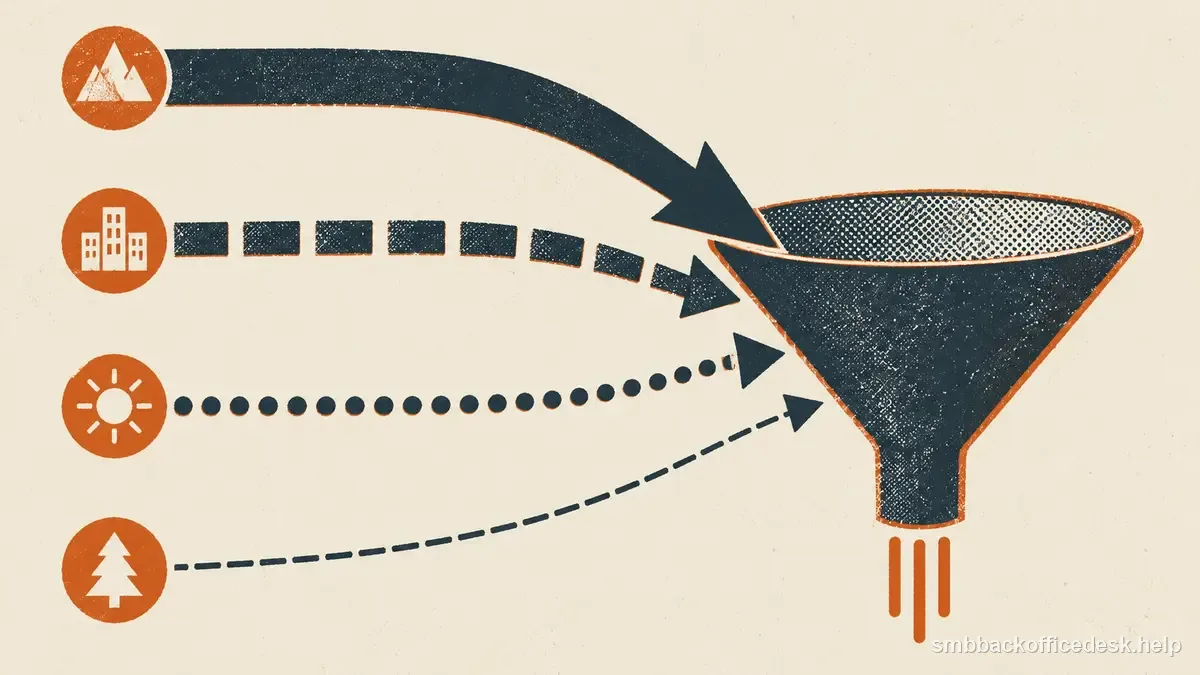
The cheapest lead list is rarely the one with the lowest price per row. A $500 file of 10,000 records looks inexpensive until half the companies miss your ICP, 20% already exist in your CRM, titles are stale, and nobody can explain where the email addresses came from. Compare vendors and internal research on cost per usable record, not raw row count.
Price the internal build honestly
Estimate the work in stages: - identify target accounts; - verify industry/geography/size; - find buyer roles; - find or verify contact channels; - deduplicate against CRM; - document source and freshness; - import and QA.
Multiply researcher time by a realistic loaded hourly cost. Include tools used for discovery and verification. If 20 hours of internal work produces 300 high-confidence records, compare that cost and quality with what a vendor actually delivers after cleanup.
Internal research has advantages when the niche is narrow, the source universe is public, or fit depends on qualitative facts vendors do not carry. It can be expensive when the market is huge and standardized fields are enough.
Demand a vendor sample before signing
Ask for a sample that matches your exact filters. Do not accept a hand-picked “demo” containing famous companies if you sell to regional contractors.
Audit the sample: - account fits ICP; - company domain is correct; - contact still works there; - title/function is current; - email result is acceptable under your policy; - duplicate against your CRM; - source/provenance is documented to the degree promised.
Calculate the usable percentage. If 70 of 100 sample rows survive your rules, the vendor’s effective cost is based on 70 usable rows, not 100 delivered rows.
Ask what “verified” actually means
Vendors use the word differently. Ask: - Was the email verified by SMTP, another method, or inferred? - How old can the title data be? - Is a catch-all mailbox counted as verified? - How frequently are records refreshed? - What happens when a record is wrong? - Can you receive replacement credits? - Does the vendor identify its data sources or collection categories? - Can suppression lists be applied before delivery?
Get answers in writing when they influence the purchase.
Check data rights and contact rules separately
A vendor’s “compliant” label does not establish that every record may be used for every purpose, channel, or country. Before purchase, confirm the source and collection category, your permitted use and any resale or sharing limits, the retention/deletion terms, and how suppression requests are applied. Separate permission to receive or use data from the technical quality of the email address.
For U.S. commercial email, the FTC says a business cannot contract away its CAN-SPAM responsibilities by hiring another company, and opted-out addresses cannot be sold or transferred as a mailing list. Apply the rules for each recipient location and channel before outreach; buying a record does not itself establish consent or contact eligibility.
Measure overlap before buying the full file
Provide the vendor with a privacy-appropriate suppression or matching mechanism if supported, or compare a sample locally. Find exact email and company-domain overlap with your CRM.
A file that is 40% duplicates may still be valuable if the vendor charges only for net-new records or fills missing contacts at existing target accounts. If you pay full price for duplicates, include that in the economics.
Also check parent companies and franchises. Apparent new accounts may roll up to organizations your team already owns.
| Vendor | Internal | |
|---|---|---|
| Best fit | Standard firmographic fields | Niche facts from specialized sources |
| Tradeoff | May need cleanup | Time grows with coverage |
| Hybrid | Buy account universe | Verify priority accounts |
Buying can be faster; building can be more specific
A vendor wins when you need broad standardized firmographics and contact data quickly, the target market is well represented, and the supplier can prove acceptable freshness.
Internal building wins when the qualifier is something like “uses a two-location warehouse,” “has a public compliance certification,” or “recently opened a second clinic”—facts a generic database may not model well.
A hybrid often performs best: buy the account universe, then manually validate fit and enrich only the top tier.
Run a paid pilot with downstream metrics
Do not judge the pilot only by delivery rate. Track usable account rate, verified contact rate, bounce rate, wrong-person replies, meeting rate, and cost per accepted record.
Compare a vendor cohort with an internally built cohort during the same period and using similar messaging. If the vendor list gets more replies only because it contains larger companies, that is an ICP difference rather than data quality.
Decide based on repeatability
A one-time list can solve a launch, but prospecting is usually ongoing. Ask what happens next month: Can the vendor provide only net-new records? Can your team refresh internal research efficiently? Does either method preserve source and suppression history?
Choose the system that can keep producing explainable, current prospects at a sustainable cost. Row count is inventory; usable, maintainable accounts are the asset.
Define rejection and replacement terms before purchase
If a supplier promises replacement credits, define an unusable record in writing: which fields must be wrong, what proof is required, how long you have to submit a claim, and whether replacements must meet the same ICP filters. Count the staff time needed to document claims; a credit that takes hours to secure may not offset cleanup cost.
For internal research, separate discovery, verification, and enrichment time so you compare both options at the same readiness stage. Use cost per accepted, nonduplicate, usable record, then compare downstream outcomes from equivalent cohorts.