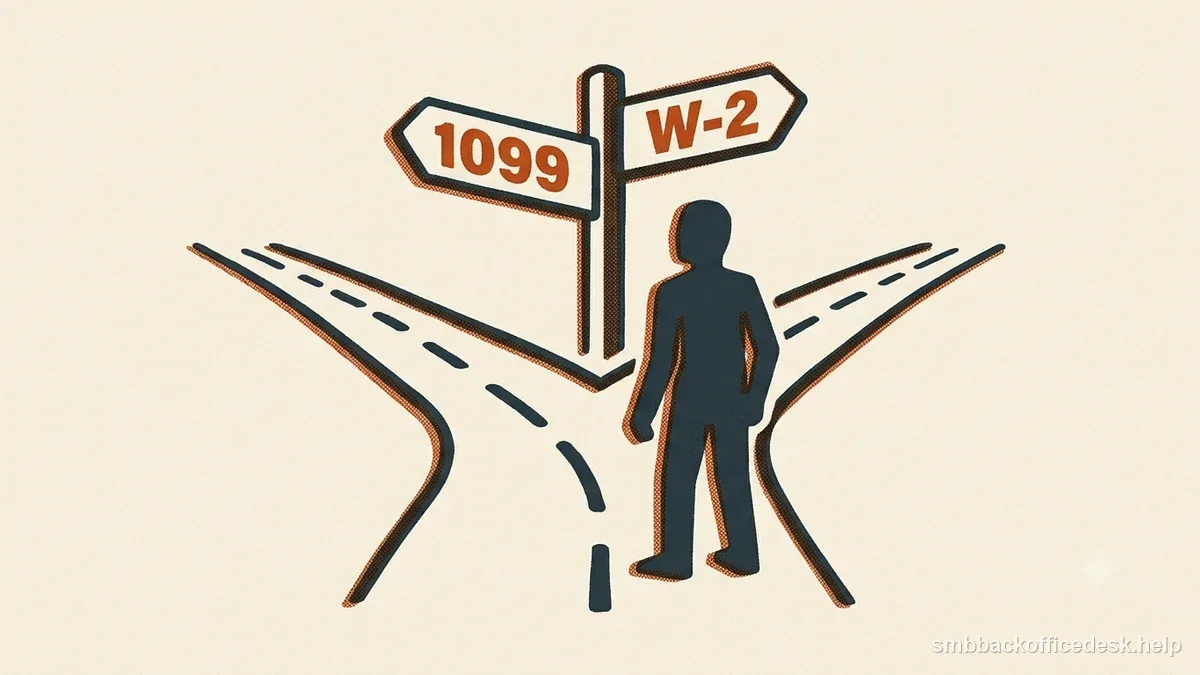
There is no single nationwide “1099 test”
A small business can classify the same working relationship under several laws. The IRS common-law test addresses federal employment taxes. The Fair Labor Standards Act (FLSA) addresses federal minimum-wage and overtime coverage under a separate analysis. States can impose different tests for wage laws, unemployment insurance, workers’ compensation, or other programs.
That means a memo saying “passes the IRS test” is not a national safe harbor. Before classifying a worker, identify which law, which state, and which agency or program controls the obligation you are trying to answer. A test used for state unemployment may not answer the state wage-law question.
California shows how different a state test can be
California’s Labor Commissioner explains that the ABC test generally presumes a worker is an employee unless the hiring entity establishes all three conditions, subject to statutory exemptions and situations where another test applies.
The three conditions are:
A — Freedom from control and direction. The worker must be free from the hiring entity’s control and direction in performing the work, both under the contract and in fact.
B — Work outside the usual course of the hiring entity’s business. This asks whether the work is outside what the business ordinarily does. A bakery hiring an outside plumber to repair a pipe presents a different fact pattern from a bakery regularly using “contractor” bakers to make its products.
C — Independently established trade, occupation, or business. The worker must customarily engage in an independently established business of the same nature as the work performed.
Failing any required prong generally means the ABC test is not satisfied. But California has exemptions and alternate rules for specified occupations and relationships. An exemption is only a routing question: it may send the analysis to another legal test rather than automatically establish independent-contractor status. Check the current statute and agency guidance for the actual engagement.
Build a jurisdiction matrix before onboarding
For each worker location, create a short table with rows for federal employment tax, federal wage-and-hour law, state wage law, state unemployment insurance, state workers’ compensation, and any relevant local or industry-specific rule.
For each row, name the legal test and administering agency. Record the work location, the facts that matter under that test, the official source URL, the review date, and any exemption or alternate-test analysis. This prevents one favorable answer from being copied into unrelated compliance files.
A remote workforce makes this especially important. The company’s headquarters state is not always the only jurisdiction that matters when a worker performs services elsewhere. Ask where the work is actually performed and which program the business is evaluating before selecting a test.
Do not assume every state uses California’s ABC test
Some jurisdictions use ABC-style tests; others use common-law, economic-reality, hybrid, or statute-specific standards. The same state can apply different definitions to different programs. Even where “ABC” is the label, wording, burden, exemptions, and legal scope can differ.
Avoid publishing or using a spreadsheet that says “ABC state: yes/no” without naming the law, purpose, effective date, and exemption notes. A simplified map can become stale when legislatures or courts change a rule. General state summaries are a starting index, not a substitute for the official current authority.
For a real hiring decision, open the current labor, unemployment, revenue, and workers’ compensation guidance for the worker’s state. If the relationship is material or close, obtain qualified local advice.
Compare the same fact across tests
Suppose a marketing agency hires a person to perform the same recurring client campaign work as its staff. Under IRS common law, the review considers behavioral control, financial control, and the type of relationship. Under an ABC test, the “usual course of business” prong may be central. Under the FLSA, the economic reality of the working relationship is analyzed under the applicable federal framework.
As of October 8, 2026, DOL’s February proposal to revise its FLSA analysis remains a proposed rule, not a final rule; DOL says it is no longer applying the 2024 rule in its investigations. Check the current DOL page and relevant court authority for the work period. A federal proposal does not change a state test by itself.
The work facts have not changed, but the legal question has. This is why “our contractor owns an LLC” or “they set their own hours” cannot answer every test.
| IRS tax | FLSA or state law | |
|---|---|---|
| Question | Right to control under common-law categories | Economic dependence or state statutory test |
| Example fact | Recurring campaign work informs control | Usual-course-of-business prong may matter |
| Conclusion | Does not automatically answer other law | Analyze under its own framework |
Keep the state file current
Set a review trigger for a worker move, role or scope change, renewal, or legal change. Record the new location and rerun the specific state programs that may apply rather than copying the old conclusion. Keep the prior analysis with its effective period so that a later reviewer can see which facts and law supported it at the time.
Do not copy dollar thresholds, penalty amounts, or exemption lists from an old article into the permanent file. Link to the official agency source and verify it when acting. If payroll asks about federal withholding, the IRS analysis should be ready; if a state unemployment agency asks about coverage, the file should show that separate test rather than a generic “1099 checklist.”