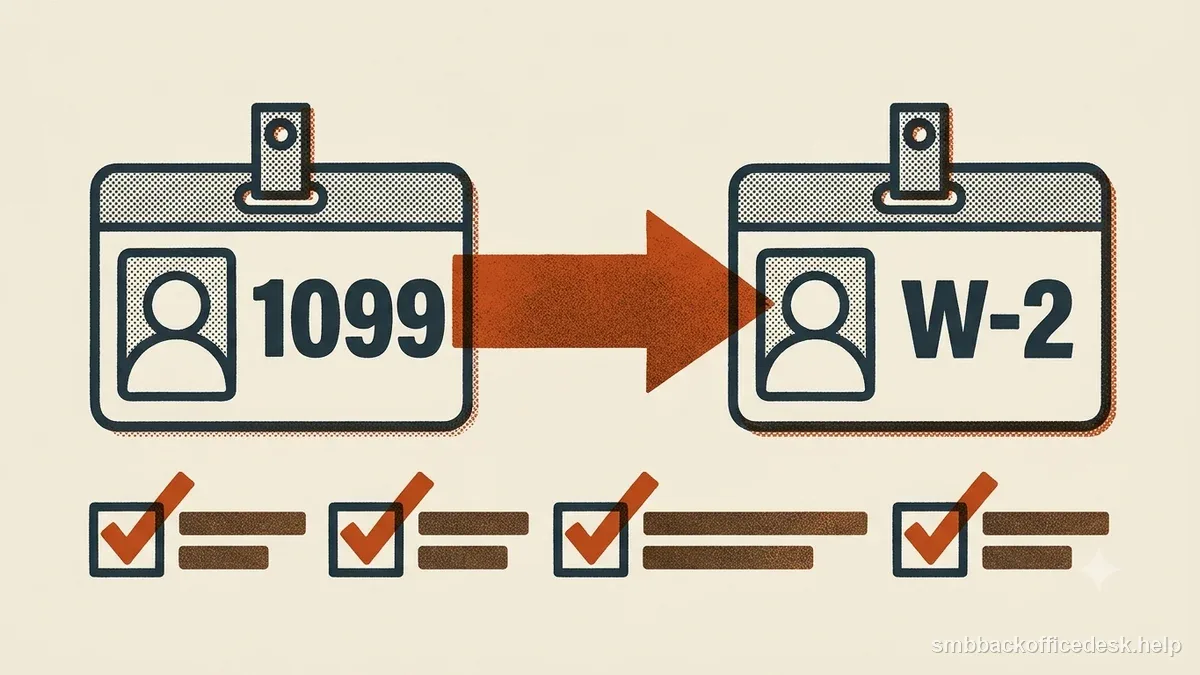
Pick an effective date and define what is changing
A conversion from 1099 treatment to W-2 employment should be more than changing a dropdown in payroll software. Write down the effective date, the role, manager, compensation structure, work location, and reason for the change. From that date forward, the company should operate the relationship as employment and meet the federal and state obligations that follow.
Do not backdate an employee start date merely to make the records look cleaner. If prior contractor treatment may have been wrong, review the earlier period separately.
- Before effective dateTie contractor payments to genuine prior services.
- Effective dateDocument role, manager, pay, and location.
- After conversionUse employee onboarding and payroll systems.
- Year endReconcile payroll, vendor ledger, and forms.
- Historical reviewAssess earlier periods separately.
Complete employee onboarding
Before the employee starts under the new status, collect the current Form W-4 for federal income-tax withholding and complete Form I-9 employment-eligibility verification on time. The employee generally completes Section 1 no later than the first day of employment and not before accepting the job offer. The employer generally completes Section 2 within three business days after the first day of work for pay; if the job lasts fewer than three business days, Section 2 is due no later than the first day. Follow current USCIS instructions for authorized examination methods and reverification, and current IRS instructions for the W-4.
Set up the person in payroll with the correct legal name, Social Security number, work location, pay frequency, compensation, and withholding elections. Determine state and local withholding and new-hire reporting requirements for the employee’s actual work state.
Enroll the worker in timekeeping if the role is nonexempt. Configure overtime, meal/rest rules where applicable, paid leave, and wage-statement requirements under the governing jurisdiction. Classification as an employee can change much more than the year-end tax form.
Move the operating relationship into the employee system
Assign the manager, job description, schedule, expense policy, security access, and performance process used for comparable employees. Review eligibility for benefit plans instead of assuming a former contractor is excluded.
Check workers’ compensation coverage and state unemployment accounts. A company hiring its first employee in a state may need registrations that were unnecessary when it only purchased services from a vendor.
Also revisit equipment and reimbursements. If the business now requires the employee to use certain tools or incur work expenses, federal and state reimbursement rules may apply differently.
Handle the split year correctly
A person can legitimately receive both Form 1099-NEC and Form W-2 for the same calendar year when the facts support distinct contractor services and employee work. In a conversion, this often means genuine contractor services before the effective date and employee services afterward; the date on a form alone does not establish that the periods were properly classified.
Do not allocate payments between the forms merely to reach a preferred tax outcome. Tie each payment to the service period and classification that actually applied.
For the employee period, withhold and deposit payroll taxes through the company’s normal payroll process and include wages on Form W-2. For the genuine contractor period, apply the information-reporting rules that govern nonemployee compensation. Keep the conversion memo with the payment ledger so year-end reporting can be reconciled.
| Contractor period | Employee period | |
|---|---|---|
| Work basis | Services actually performed before conversion | Employee work after effective date |
| Payment path | Valid contractor invoice/reporting | Payroll withholding and wages |
| Control | Do not backdate or force preferred tax result | Do not route employee services through vendor pay |
Review the past without assuming the conversion cures it
Moving someone to payroll today does not automatically resolve whether they should have been an employee last year. If the earlier facts were substantially the same, consider a historical classification review.
For federal tax exposure, questions may include amended employment-tax returns, Section 3509 calculations, Section 530 relief, or eligibility for the IRS Voluntary Classification Settlement Program. VCSP has specific eligibility rules and uses Form 8952; do not assume every conversion qualifies.
State withholding, unemployment, workers’ compensation, wage-and-hour, or benefit obligations may need separate analysis. A federal tax solution is not a universal settlement.
Communicate the change clearly
Give the worker a written notice explaining the effective date, pay basis, payroll schedule, withholding, benefits information, timekeeping requirements, expense process, and who to contact with questions. Avoid telling the worker that W-2 treatment automatically means they will take home less or more; withholding and individual tax circumstances vary.
If compensation is being renegotiated because the company will now bear employer payroll taxes or offer benefits, document the new wage independently from the classification conclusion. An employee must still receive all wages required by applicable law.
Close the contractor setup
Stop future contractor invoices for employee work after the effective date. Disable duplicate vendor-payment routes that could accidentally send off-payroll compensation. Reconcile outstanding contractor invoices for services completed before conversion.
Update vendor-management records so the worker is not simultaneously treated as a supplier and an employee for the same services. Preserve prior contracts and invoices; do not delete them simply because the relationship changed.
Schedule a post-conversion check
After the first payroll and again before year-end, verify withholding, tax deposits, work-state setup, time records, benefits, expense reimbursements, and the split between pre-conversion contractor payments and employee wages.
A clean conversion has three distinct records: why the status changed, exactly when payroll treatment began, and how prior periods were evaluated. That record is far more defensible than quietly replacing a 1099 with a W-2 and hoping nobody asks when the relationship actually changed.